


Like so many of my kind, I love to read about The Recent Unpleasantness. There is a lot I could say about being Southern and the unique nature of our sentimentality toward our past, but I digress. However, being this way, and with the reading habits my kind tend to keep, I often find myself learning new things about the old conflict and the men who participated in the bloodletting, both blue and gray. After more reading, I find myself once again astounded by the inexhaustibility of the subject and my supreme ignorance of it…
Take for example the little known story of Capt. Arthur H. Keller.
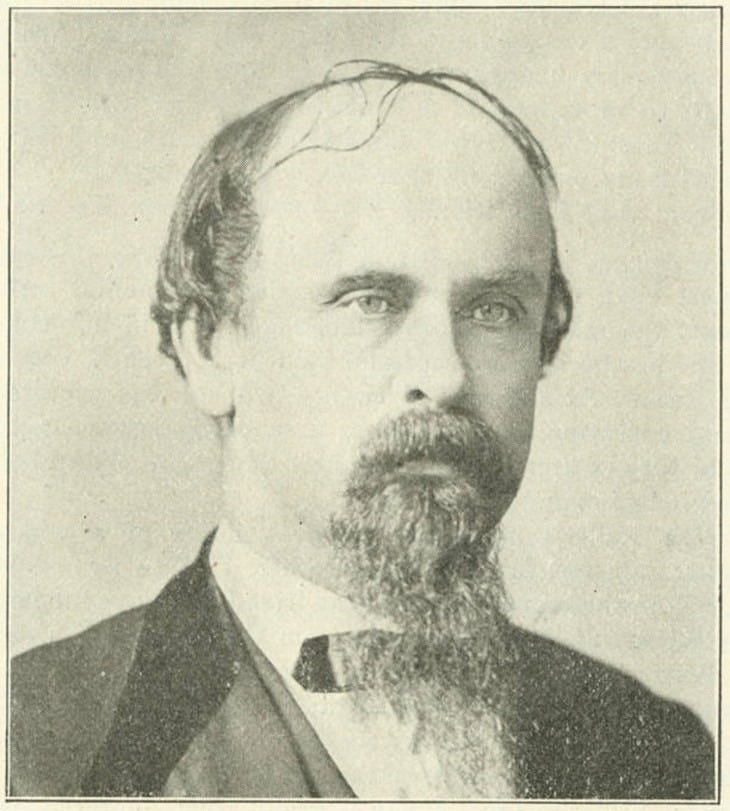
The Keller family first settled in Maryland after leaving their native Switzerland in the mid-1700s. From there the family made their way to Tennessee, and finally settling in north Alabama in the town of Tuscumbia. It was there that the family built their plantation which they named “Ivy Green,”
When the war broke out, the Keller family supported the Confederacy, with the most notable involvement in the conflict being that of Capt. Arthur H. Keller, and his older brother, Dr. James M. Keller.1 Arthur would go on to join the 27th Alabama Infantry in 1861, while his brother would travel to Memphis to establish a military hospital under the order of their distant relative, Dr. Samuel Preston Moore, Surgeon General, C.S.A.2
Shortly after his enlistment, Arthur would be appointed Quartermaster Sergeant for the 27th Alabama Infantry and find himself deployed in the force that made a series of small fortifications on Stewart’s Hill within cannon range of Fort Henry.
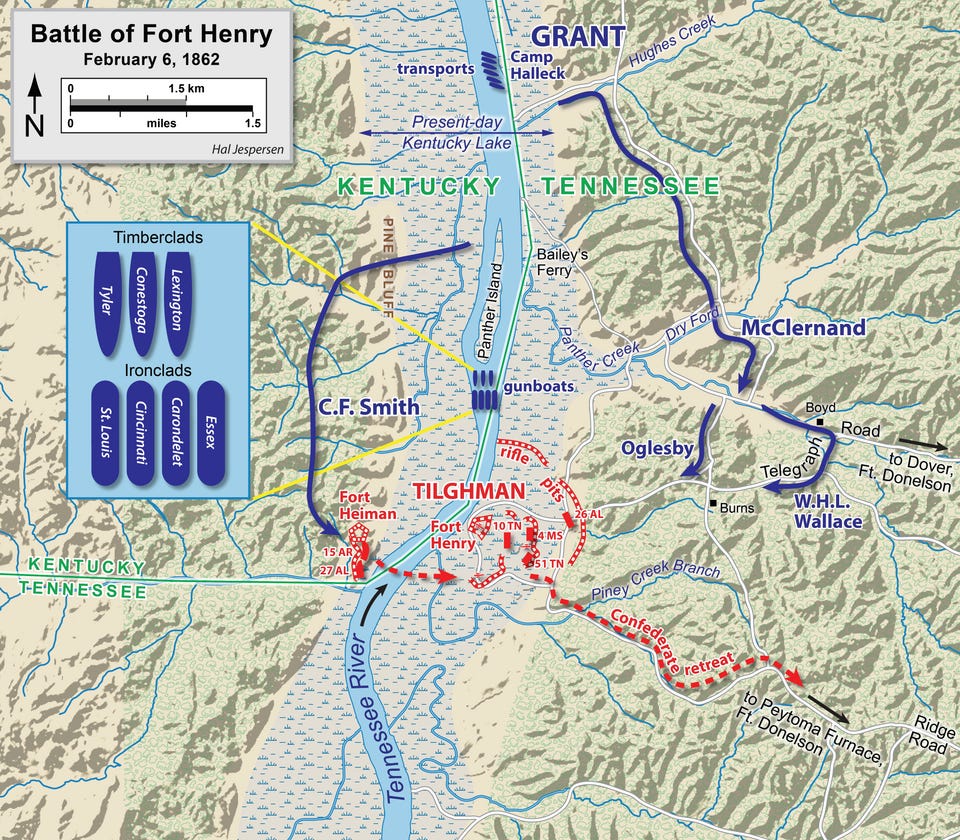
They called their position Fort Heiman, named for Col. Adolphus Heiman, commander of the 1st Brigade, who was present in Fort Henry Proper.3
Shortly after this, most of the regiment was captured at the surrender of Fort Donelson. Those who escaped the surrender were reorganized into two companies and were consolidated with a Mississippi regiment that has eluded me in my limited research.4
However, fate would have it that the young Sargent Arthur H. Keller would inadvertently escape capture as he was posted at a supply depot 188 miles away in Florence, Alabama. Shortly after this, two Yankee gunboats would make their way to Florence, leaving the Confederates no choice but to burn the very supplies that Sargent Keller had once had in his charge.56
While the main body of his regiment was imprisoned, Sargent Keller would serve on General Sterling A. M. Wood’s staff in Florence for a time. After his service on the general’s staff he would find himself joining the 4th Alabama Cavalry Regiment under Colonel Philip D. Roddey as a private. Roddy’s Cavalry was raised from his home town in Tuscumbia, Alabama.7 It is unclear to me if he saw any action with the 4th Alabama Cavalry.
In September of 1862, the imprisoned men of the 27th Alabama were exchanged and taken to Vicksburg, then reunited with the two other companies that were not captured at Port Hudson and assigned to Beall’s and Buford’s Brigade, Department of Mississippi and East Louisiana. 89
Sargent Keller would rejoin the 27th that very month and be promoted to Captain on the 24th. The newly commissioned Captain would go on to serve as the regimental quartermaster officer until August of 1864. From September of 1862 to August of 1864, the 27th Alabama would see hard service at The Battle Of Champion Hill, The Battle Of Black River Bridge, and in the trenches at the Battle Of Jackson during the Vicksburg Campaign. Retreating with the army across the Pearl River in July of 1863. In February of 1864, the record shows Captain Keller procuring corn and other supplies for the 27th in Demopolis, Alabama.1011
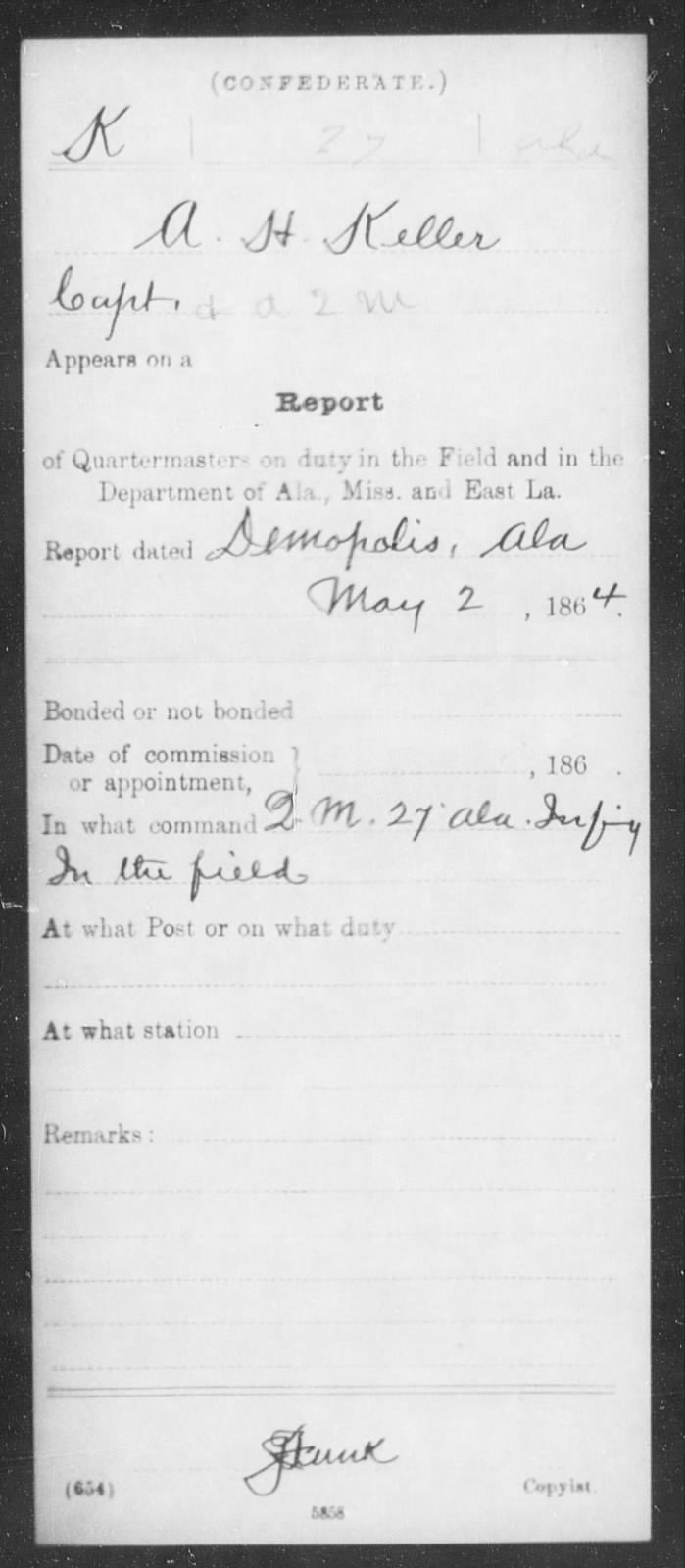
By the spring of 1864, the 27th joined with the Army of Tennessee and was attached to General Scott's and Shelley's Brigade. That May, the 27th would be sent to Georgia to fight Sherman as he was working his way to Atlanta, under Colonel James Jackson who was commanding the unit at the time. 1213
The 27th would arrive in Georgia in time to fight in The Battle Of Resaca on the 13th of May, 1864. The unit would continue to be engaged in heavy fighting around Atlanta as Sherman pressed South. Through the months of August and September, Captain Keller’s name appears on reports from the Atlanta area.14
Around this time Captain Arthur’s friend Colonel Philip D. Roddey was promoted to Brig. General. Captain Arthur then received orders to report to Roddey’s Brigade to serve as paymaster for for Roddey in the Tennessee Valley. During this time, Captain Arthur would ride with Roddey’s Cavalry Brigade supporting Gen. Nathan Bedford Forrest defending the Valley from Union General James H. Wilson’s invasion of Alabama.1516
The Brigade’s final action would be on April 2nd, of 1865 at The Battle Of Selma where most of General Roddey’s command was captured. Captain Keller would escape capture, but would ultimately surrender with the last of Roddey’s men at Pond Springs (now Wheeler), Alabama, in May 1865.1718
Captain Keller was a Southern warrior, as described in an advertisement in the Moulton Advertiser.
The many friends of Capt. A. H. Keller, of Tuscumbia, will make application to President Cleveland, at the proper time, to have him appointed United States Marshal for the Northern and Middle Districts of Alabama. Capt. Keller is a gentleman of commanding appearance and ability. For many years he has been and is now the bold and fearless Editor of the North Alabamian, and whenever his sharp blade was raised the enemies of good government went down like ripe grain before the reaper. He has labored faithfully for his party---has stubbornly refused positions of honor, preferring to battle in the ranks until the vultures were entirely routed, and now that Victory has been achieved by our grand old party, Capt. Keller comes to the front---thro’ his friends---and will ask for the above position. President Cleveland will not find it an easy matter to ignore his claims.---Moulton Advertiser.19
Captain Keller would also become the long-time editor of The North Alabamian where he would write articles complementing the ex-Confederates of the region, and he even served as the commander of Tuscumbia’s local United Confederate Veterans Chapter. He rightly believed that the South was Martyred by the aggression of the North.20
On August 29, 1896, following an illness of ten days, Captain Keller would pass in his family home “Ivy Green.” He would be buried the next day on the 30th in Tuscumbia’s Oakwood Cemetery.21
In life he also gave birth to a famous daughter. That would be a Miss Helen Keller.
Greetings, everyone. I want to say that you will find I utilized a few Wikipedia articles. I am normally not a fan of using that website, but I was looking for details about the timeline for the regiments that the NPS website could not offer me. I also used it for a few location details to supplement Richard C. Sheridan’s article which I originally found on facebook. I used the NPS website, Wikipedia, FOLD3, and a few more specialized websites to make sure his claims were accurate, and to expand the limited scope of his original article.
FOLD3 helped the most as I was able to find all the records for Captain Keller’s service, and in my research was unable to find any contradiction between the original article, the NPS, Wikipedia, FOLD3 records, and the few other sites that I used, which I am very happy to report. If I had the regimental history books for all of the different units involved, they would have been consulted before Wikipedia, but I unfortunately do not have access to them.
Thank you for reading, I hope you enjoyed this one, I know that I had a lot of fun with it. — J.R. Dunmore
The Civil War Experiences of Captain Arthur H. Keller By Richard C. Sheridan
http://www.jamesmkeller648.org/drjmk.htm
Wikipedia as accessed on 2/7/26 & https://civilwartalk.com/threads/fort-henry-confederate-order-of-battle.215323/
https://www.nps.gov/civilwar/search-battle-units-detail.htm?battleUnitCode=CAL0027RI
https://www.battlefields.org/learn/articles/nothing-god-almighty-can-save-fort
The Civil War Experiences of Captain Arthur H. Keller By Richard C. Sheridan
https://www.nps.gov/civilwar/search-battle-units-detail.htm?battleUnitCode=CAL0004RC01
The Civil War Experiences of Captain Arthur H. Keller By Richard C. Sheridan
https://www.nps.gov/civilwar/search-battle-units-detail.htm?battleUnitCode=CAL0027RI
The Civil War Experiences of Captain Arthur H. Keller By Richard C. Sheridan
https://www.nps.gov/civilwar/search-battle-units-detail.htm?battleUnitCode=CAL0027RI
The Civil War Experiences of Captain Arthur H. Keller By Richard C. Sheridan
https://www.nps.gov/civilwar/search-battle-units-detail.htm?battleUnitCode=CAL0027RI
The Civil War Experiences of Captain Arthur H. Keller By Richard C. Sheridan
The Civil War Experiences of Captain Arthur H. Keller By Richard C. Sheridan
https://en.wikipedia.org/wiki/Phillip_Roddey
The Civil War Experiences of Captain Arthur H. Keller By Richard C. Sheridan
https://en.wikipedia.org/wiki/Phillip_Roddey#cite_note-7
https://sites.rootsweb.com/~alcolber/bio-keller-family-nwspr.htm
The Civil War Experiences of Captain Arthur H. Keller By Richard C. Sheridan
The Civil War Experiences of Captain Arthur H. Keller By Richard C. Sheridan
So why did he fight to keep slavery....
totally immoral. The South had way too much false pride and should not have attacked the north to start a war that killed 500,000 Americans! Keller was very wrong! The South should have just freed their slaves and repented for such cruelty to God Almighty!!