


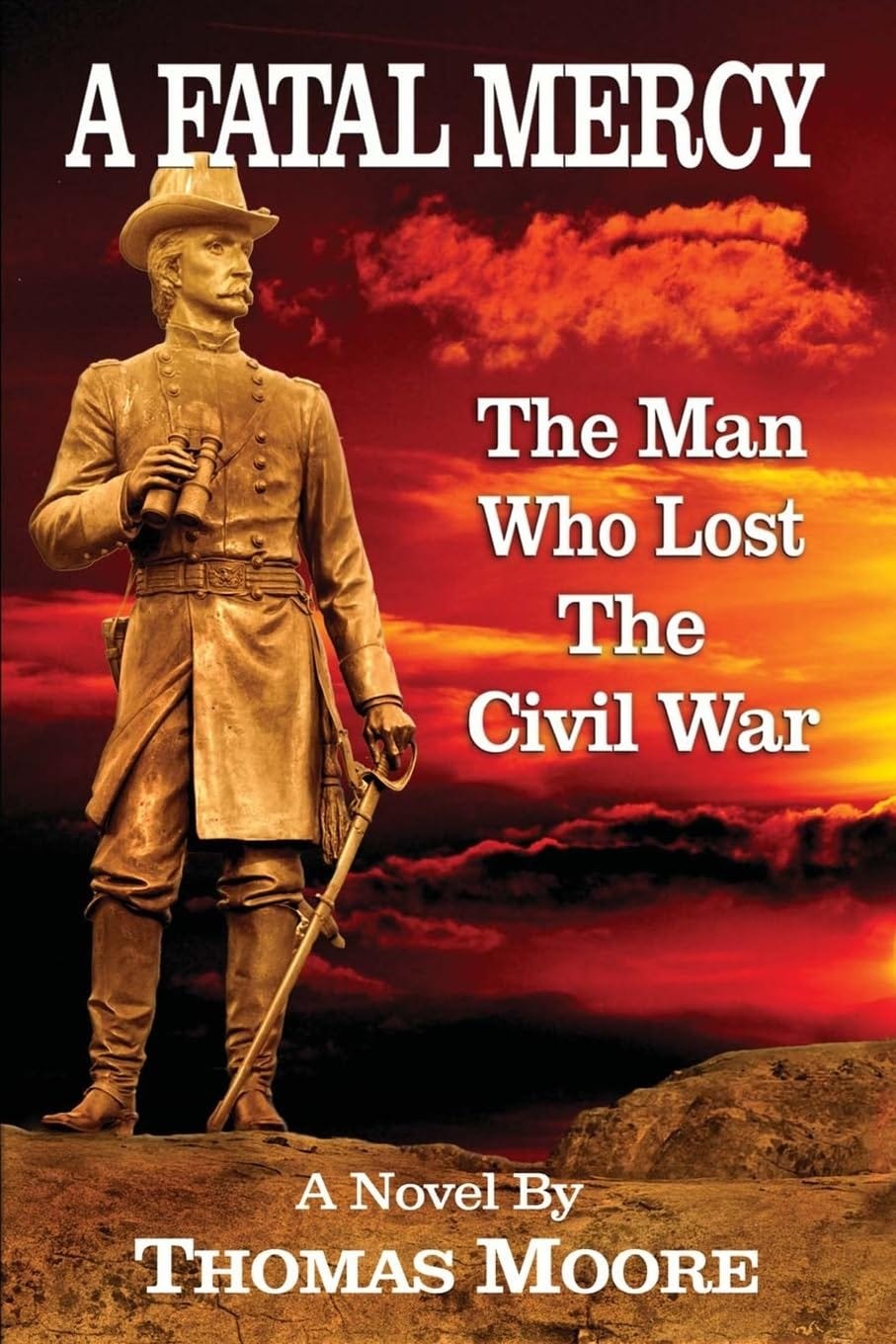
Long ago, much longer than I’d care to admit, I was approached by a gentleman concerning his late father’s novel. He told me a little bit about it, and seeing that it was a novel of The Recent Unpleasantness and its aftermath, I figured it was worth my time to read and review. The title of the book was ‘A Fatal Mercy,’ authored by Thomas Moore, and published by our friends over at Shotwell.
Plot
‘A Fatal Mercy,’ is the story of Drayton FitzHenry, the middle son of prominent South Carolina planter and politician, who circumstance forces to participate in a conflict of arms that he himself doesn’t fully believe in. The novel follows him through the years, from 1860 until 1913, and in it’s pages, weaves together the hopes and dreams of youth with the pain and regret of age, and how a life spent in grief and anguish over its role in the war can maybe just find peace after the dust settles. Because as you will see once you read it, his war never ended. My summary here doesn’t do it justice, but I can only say so much without spoiling the book.
Theme & Genre
A Fatal Mercy is a piece of literary fiction disguised as a Civil War novel. In fact, I would argue that while the War Between The States was the central event in the main character’s life, and the event that much of the novel is set in, it is really a novel about Drayton’s interior life and how he responds to things like duty, personal honor, pride, and even love… especially love.
There were times that I felt the work drifted from the realm of prose fiction into historical lecture by the author about the circumstances of the day, and while the inclusion of these passages can be informative to readers who may be unaware of the history, I found it unnecessary and at times cumbersome, what you might call a historical info-dump. While these occasional disruptions to the plot were present, they were hardly unforgivable, and more than once, I even found myself learning something new.
The author did a great job of interjecting historical views of the day into the characters in a very natural way without it coming off as the thinly veiled pontification of a partisan’s pen (something that many novels of the war suffer from). This wasn’t just true for the politics and historical perspectives in specific, but that the entirety of the complex plot and all of the characters were brought to life with equal tact, and I thoroughly enjoyed the cast. I was especially tickled to see William Gilmore Simms come to life on the pages.
Style
The style of the first chapter threw me for a bit of a loop. What I mean by that, is I was caught off guard by the use of third-person present progressive tense, which is something like “John Smith is watching the Indian, as a friend arrives beside him. His friend turns to face him… etc.” Just something that I wasn’t accustomed to seeing in a work of prose fiction. That being said, this didn’t persist, and as far as I can remember, it didn’t continue further in the novel at any other point, and the author promptly returned to a more traditional third-person past tense.
Apart from the somewhat strange tense that chapter one was written in, I found his style approachable and smooth. Very seldom did I think that the dialogue was clunky or unrealistic, and these few instances may very well have been due to the difference the author’s age and my own.
I was very impressed with how Mr. Moore was able to play with time and being by having the chronological order of the chapters and occasionally character perspectives change frequently throughout the book. To do this and keep it all coherent from chapter to chapter is no easy feat for a writer, and I found this quite enjoyable. It was also heart-rending to see the trials and triumphs unfold in this manner, as I often found myself privy to information that the character wasn’t aware of yet.
Final Thoughts
I found this book to be quite enjoyable, and there was a certain point where I went from reading it to really devouring it. The history is well researched, the prose is clean and well written, the plot is complex and well executed. I really don’t have many complaints at all, and those that I do have, I will fully acknowledge are me nitpicking. However, I will say that the fact that I have to nitpick to find flaws should indicate to you dear reader, just how strong the work is.
I think if you enjoy good writing and novels centered around the War Between The States, this is a great book to read. I laughed, and toward the end, even cried. In some ways I found that I could really identify with Drayton FitzHenry and his reluctant acceptance of duty under the circumstances of life or perhaps more likely, the providence of God. All in all, I thought it was a great read and look forward to reading it again down the road.
You can find ‘A Fatal Mercy’ here for purchase.